App audit for the App Store and Google Play
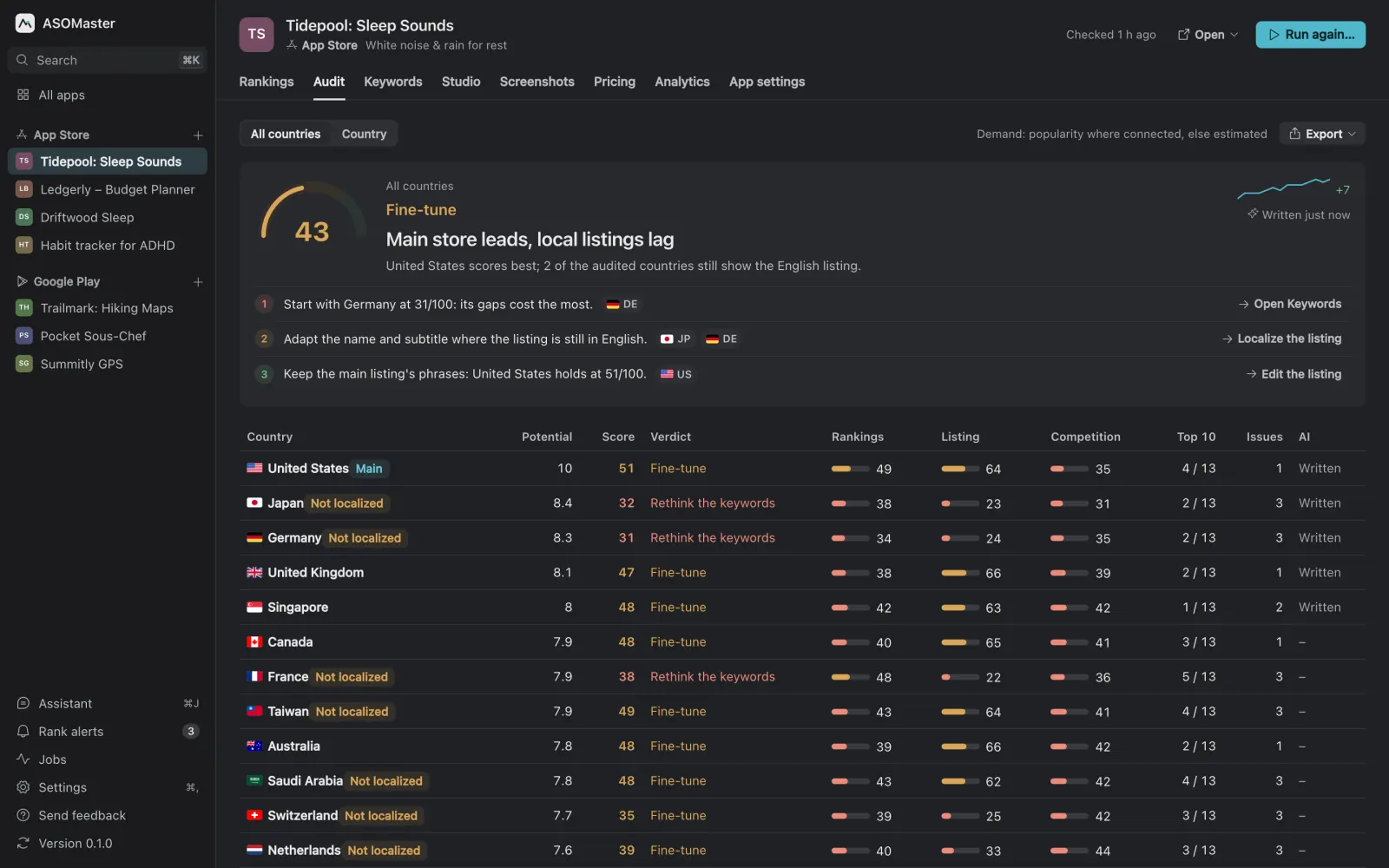
ASOMaster's audit gives your app a score from 0 to 100 in every market you track, and one across all of them. Each score is made of three parts: how well you rank, how well your listing holds the phrases people search, and how beatable the apps above you are. Under the score you get the issues to fix, the phrases you are missing and the competitors you are measured against, each with a button that opens the right place in the app. The scores need no AI; an AI written verdict is optional.
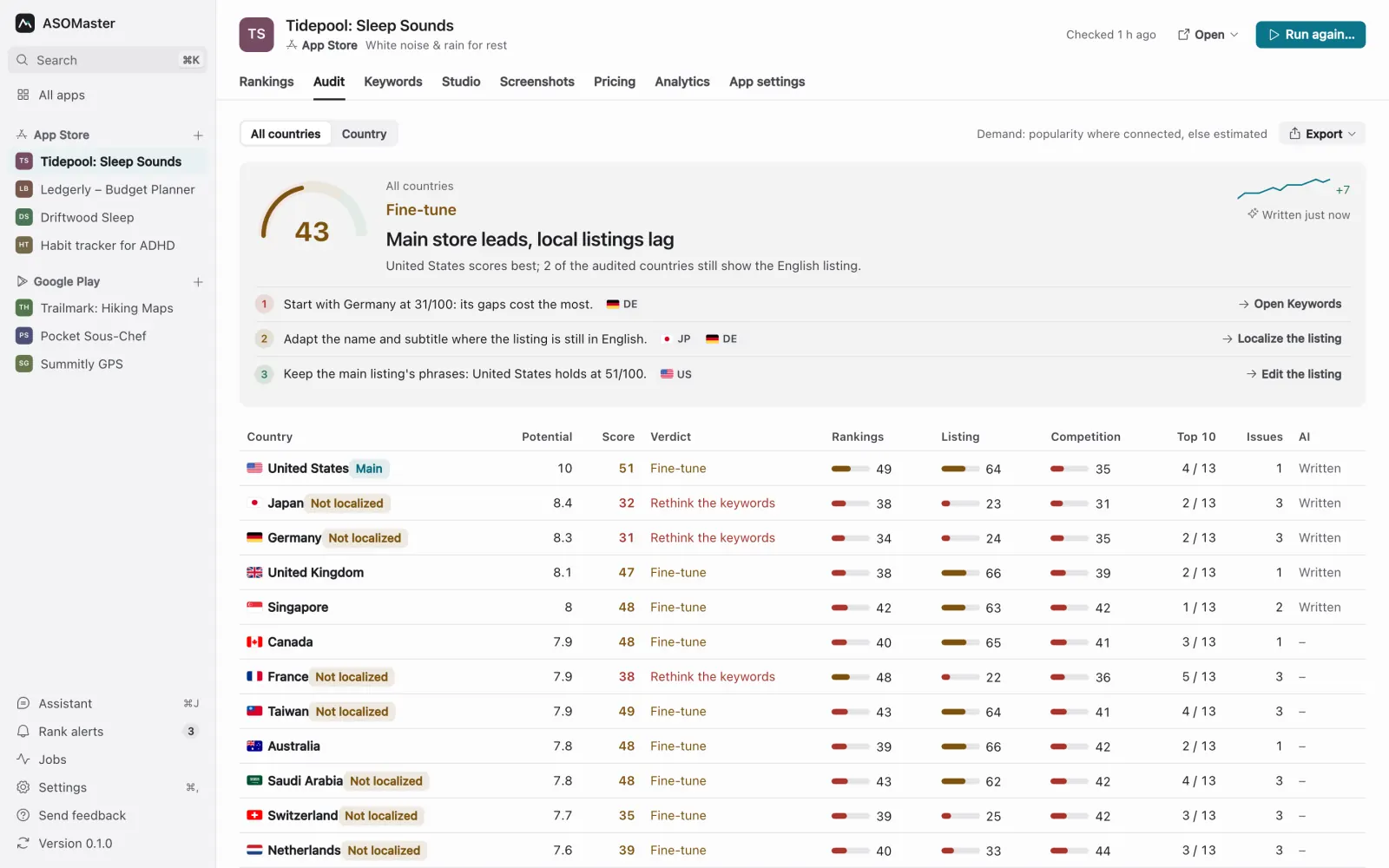
How is the score made?
In each country the score is a weighted mean of three parts. Rankings count for half, the listing for 30% and competition for 20%. Only the parts that can be measured count, so a new app with no ranks yet is scored on its listing and competition. The score can never be more than 30 points above the rankings score: a well written listing that nobody finds is not a good result.
- Rankings. Every checked phrase counts, weighted by how much people search it. Rank 1 counts fully, rank 10 three quarters, rank 20 a little under half, and the curve runs down to nothing at rank 200.
- Listing. How well the fields hold the words people search, read from that country's own listing. On the App Store that is the name, subtitle and keyword field; on Google Play the title, short description and full description. The name or title weighs most.
- Competition. For each phrase with demand where you are not already in the top three, ASOMaster looks at the apps ranking above you, sized by their ratings (installs on Google Play) and adjusted for how many ratings apps get in that market. Your own apps and apps from your developer account are left out. Each market gets a label: beatable, within reach or well defended, plus the single best chance.
Demand is real popularity where you have connected Apple Ads, Google Ads or an imported file, and ASOMaster's estimated volume everywhere else. The page tells you which one it used. The full definitions are in Metrics explained.
How do the countries add up?
The overall score is the average of the country scores, each weighted by the market's potential: a 0 to 10 measure of how much a market is worth on that store, with the US at 10. A weak score in a small market moves the total less than the same score in the US or Germany. Every country gets a verdict, and so does the whole app:
- Rethink the keywords: the listing misses what people search, or the app is hardly found while big gaps stay open.
- Fine-tune: a solid base with room in the listing or the ranks.
- On track: ranks, listing and competition all hold up.
What does a country view show?
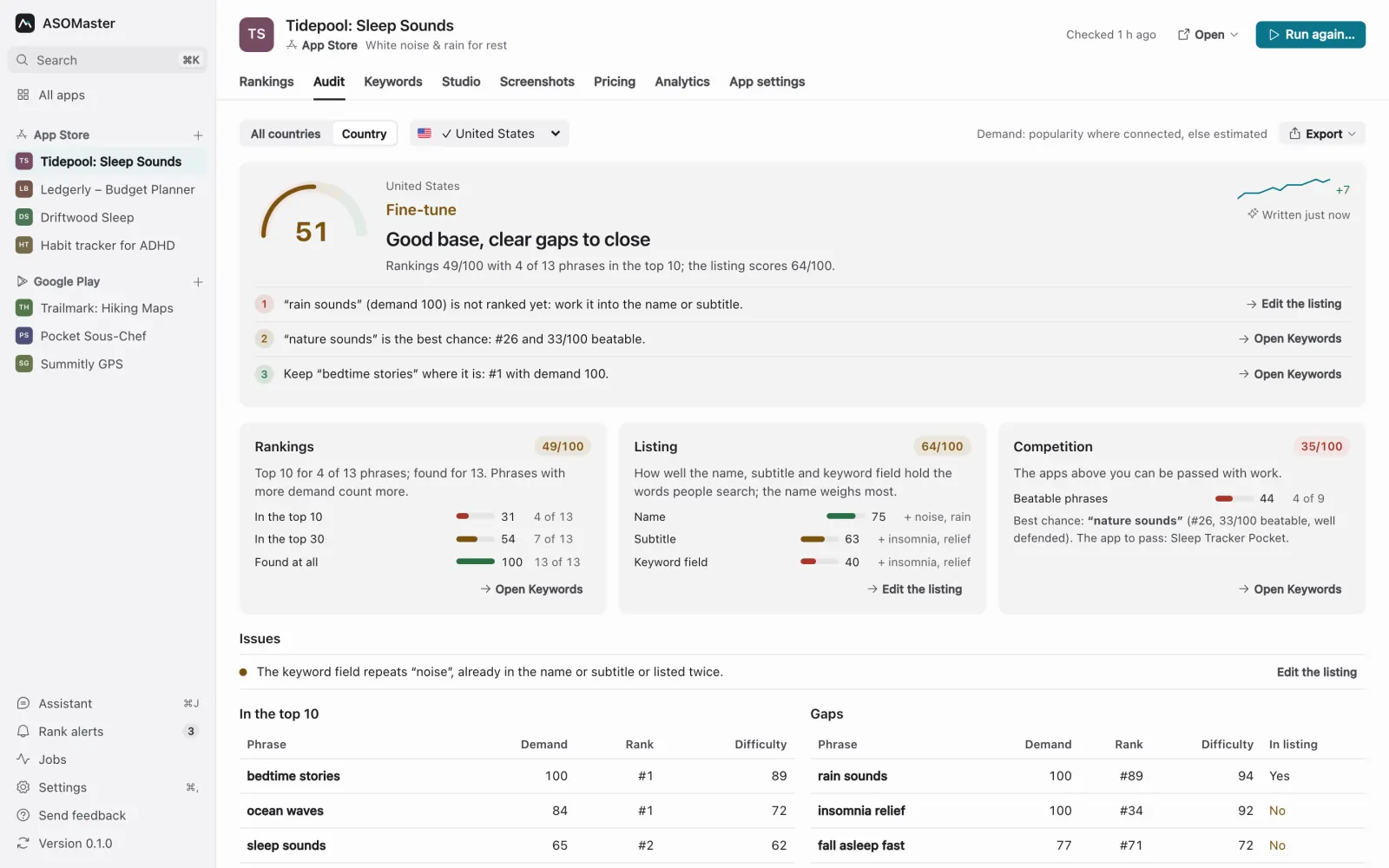
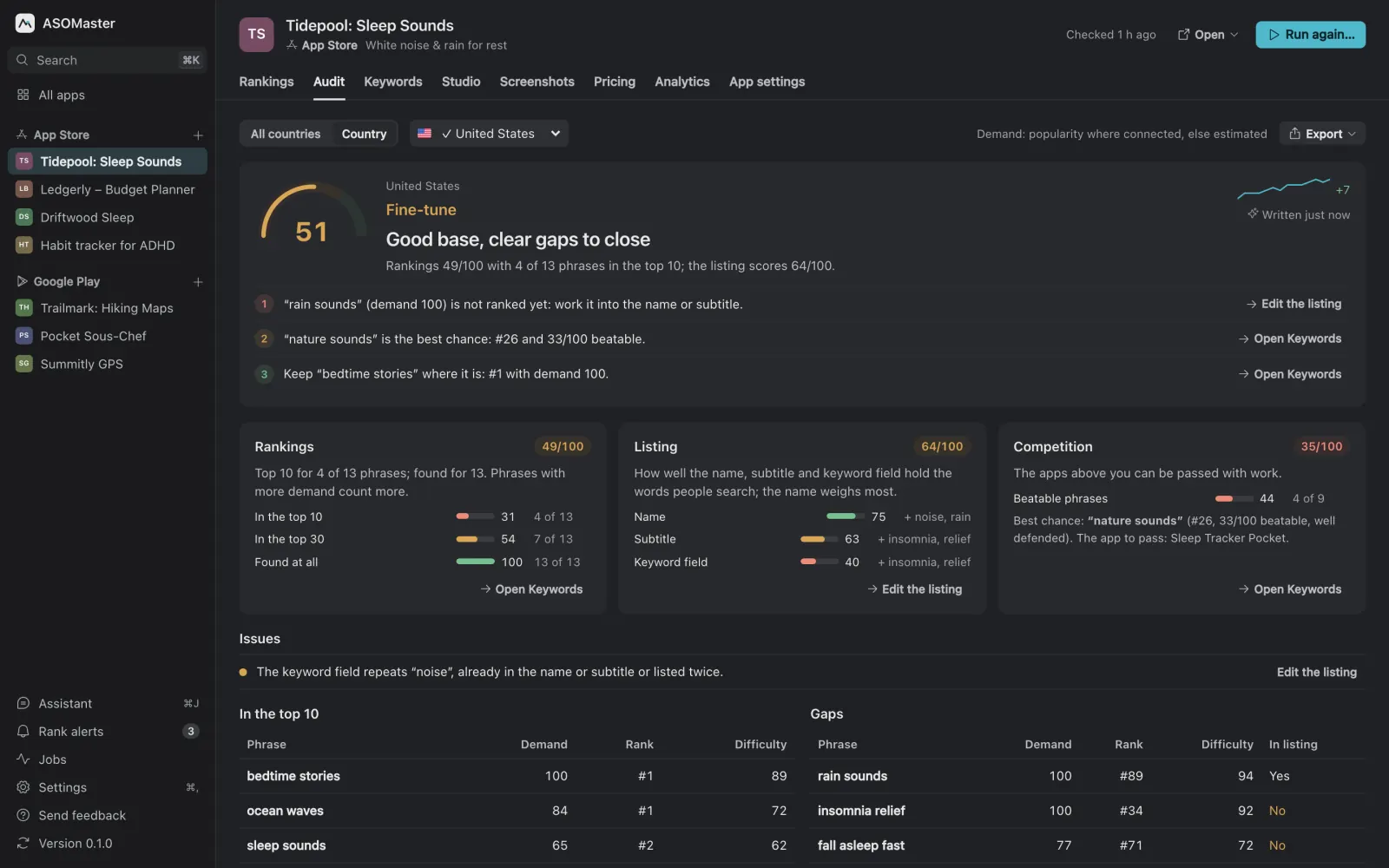
- In the top 10: up to 12 phrases you already rank well for, with demand, rank and difficulty.
- Gaps: up to 12 phrases with real demand where you rank worse than 30 or not at all, and whether the listing already contains them.
- Competitors: up to 10 apps ranking above you, with how many of your phrases each one holds in the top 10. You can dismiss one that isn't a real rival; its ranks still count in the score.
- Issues: the top phrase missing from the name, a name that doesn't lead with its best phrase, a subtitle that repeats the name, keyword field words that repeat, are ignored or match nothing, unused room, empty fields, a missing localization, device or platform words that risk a review rejection, and on Google Play phrases missing from or stuffed into the full description.
Each issue has a button that opens the fix: Keywords, the listing or description in Listing Studio, localization, or the screenshot designer. Phrases on your don't-target list stay out of the gaps and issues.
What does the AI add?
Nothing, unless you ask. When you run the audit you can choose the countries, re-read the listing from the store, re-check every phrase, have AI suggest more keywords, and have AI write the verdict. With that last option, your own AI tool writes a short headline, the reason and three to six takeaways per country, then one summary across countries, each takeaway with the button for its fix. Every number in the AI's text has to appear in the measured facts; an answer that invents one is sent back once for repair and dropped if it still doesn't match. AI runs on the tool you already use.
Does it track the score over time?
Yes. ASOMaster records one score per day after a rank check or an audit run and shows the last 90 days. If a score falls 10 points or more below the previous record, you get a desktop notification (when notifications are on in Settings). Pair it with rank alerts to see which phrases caused the drop.
What does a real audit look like?
The ScreenDock case study walks through the audit of a new Android app across 18 markets: an overall score of 11, the verdict "Rethink the keywords", and what ASOMaster suggested doing about it.
What it doesn't do
- Screenshots and ratings are not scored. Ratings are used only to size the apps above you.
- History starts with your first check; there is no score for the months before you tracked the app.
- It audits your own apps' listings. To study a rival, track it as its own project and compare ranks on the rivals panel.
For the method behind the numbers, read competitor analysis for apps and keyword difficulty and volume, or start with the app store optimization guide.